
61 Things Worth Knowing About How Singapore Was Designed, on Its 61st Birthday
An architect returns to Singapore, this time as a mother, and looks at the 61 planning and design decisions hidden inside the city's everyday convenience.
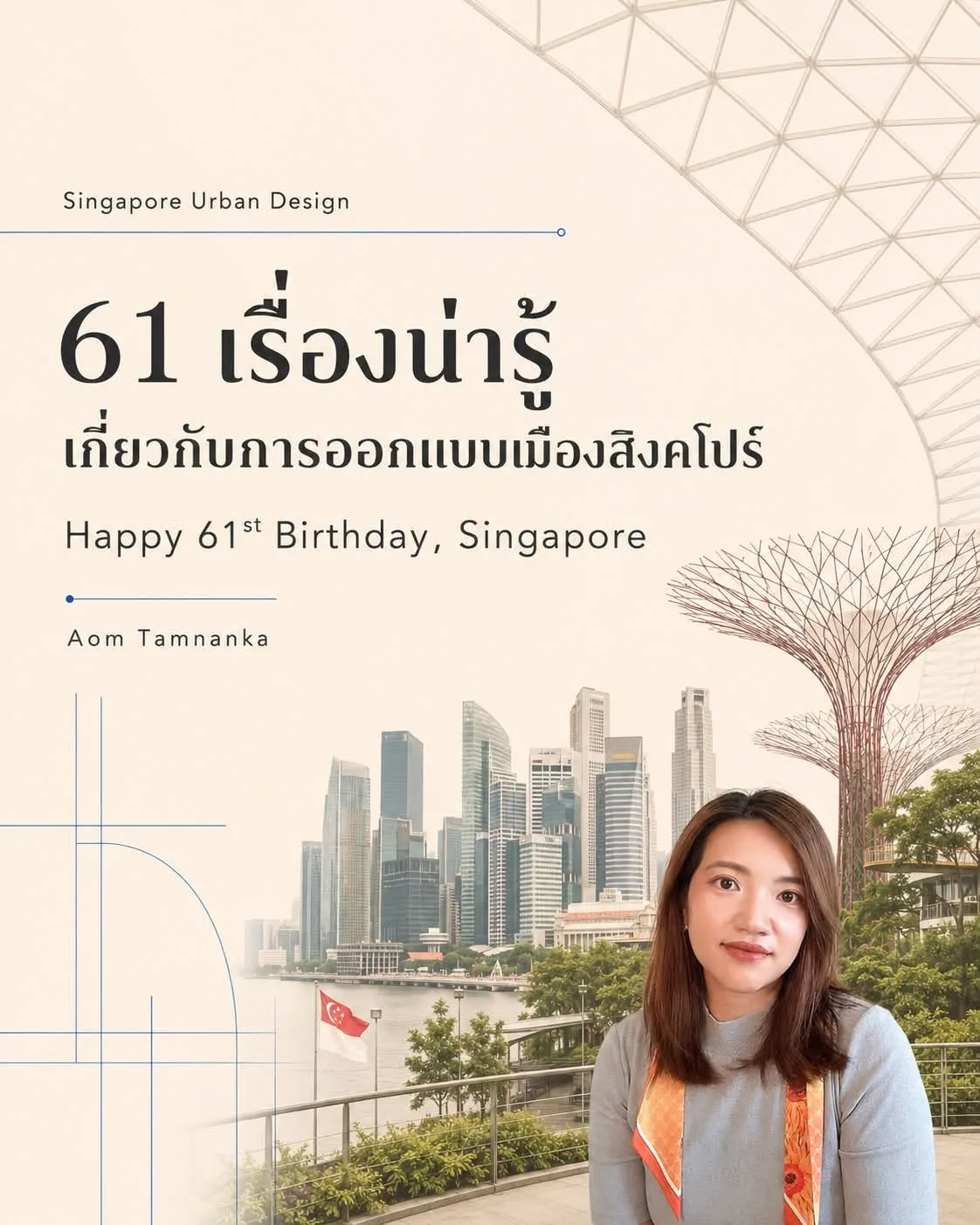
Singapore has always felt to me like a city that never stops changing and growing. I first came here straight after graduating, around 2009 to 2010, when I applied for a job and got the chance to work here as an architect. What was meant to be a few years of experience turned into a long stay, from 2010 until 2018, and I got married in the year Singapore turned 50.
After that I went back to Thailand to start my own company, and lived there for several years. Then this year, 2026, I moved back to Singapore again.
The same city, seen through a mother's eyes
This time feels very different from my twenties. Back then I was a young architect, and life was mostly work, home, and learning as much about the job as I could. Now I have come back as a mother, with children at school and a family, and I use the city in a completely different way.
So I started noticing small things I never used to think about. Why can I walk my children to school? Why is it so easy to walk from home to the train, change to a bus, do some shopping and come back again? Why can we get around when it rains without carrying an umbrella? And why are there playgrounds, exercise corners, places to eat, shops, schools and parks all within walking distance of home?
Living here again, I realised how much of what makes Singapore interesting sits at a level we barely notice anymore, because it has become part of everyday life. So much of it has been thought through as one connected system. Singapore has taught me a great deal, about work, planning and management, and about how to let many complicated things live well together.
Sixty-one years, one generation
This year Singapore turns 61. When I think about it, 61 years is really only the span of one generation. Yet looking back at how much this city has changed in that time, it is remarkable.
So for this year's National Day, I wanted to gather 61 things worth knowing about how the city is planned and designed, and how they shape the daily lives of the people who live here. Let's look at what this small city has thought about for us over the past 61 years.
Planning for the next generation
- 01Singapore plans its land use roughly 50 years ahead, setting aside space for what the next generation will need.
- 02The long-term plan is reviewed about every 10 years, so the city can adjust to changes in population, the economy, technology and the way people live.
- 03The 50-year picture is broken down into a Master Plan covering 10 to 15 years, turning a long-term vision into land use that can actually be built.
- 04The Master Plan is reviewed every 5 years, because a city needs a long-term direction and the ability to adapt along the way.
- 05Almost 220,000 people took part in the most recent round of planning, so the needs of the people who actually use the city become part of the process.
- 06Roads, water, power, housing and utilities are coordinated years in advance, so one system does not take the space of another or cause problems later.
Homes for every stage of life
- 07Even if the population stops growing, Singapore may still need more homes, because families are getting smaller, more single people live alone, and more older people live in small households.
- 08The city therefore needs many kinds of homes, for singles, couples, families with children and older residents.
- 09Almost 80% of residents live in public housing built by the Housing & Development Board (HDB), so the quality of public housing directly shapes the lives of most people in the country.
- 10About 90% of HDB residents own the home they live in, which ties housing to both security and a sense of ownership in the community.
- 11HDB sets ethnic proportions for each block and neighbourhood, to prevent single-ethnicity enclaves and encourage people to live together.
- 12Housing estates are planned with food, shops, healthcare, schools and places to relax, so daily life can happen as close to home as possible.
- 13Some new homes are placed near older estates, so parents, children and extended families can live close by and look after one another more easily.
- 14Singapore plans to add around 40,000 preschool places between 2025 and 2029, so families can find childcare closer to home and work.
- 15Special education schools are spread across the island, so families do not have to travel further than necessary.
- 16Newer community hubs bring libraries, food, sport, healthcare and community activities together, so people can do several things in one trip.
A city getting ready to age with its people
- 17By 2030, around 1 in 4 Singapore citizens will be 65 or older, which makes ageing one of the biggest design questions for the city today.
- 18Singapore is adapting homes, streets, transport and healthcare so people can grow old in the community they know, without having to move away from familiar surroundings.
- 19Active ageing centres are spread close to homes, so older residents keep meeting people, exercising and taking part in activities, and are less likely to become isolated.
- 20When locating senior centres, planners look at both the current number of older residents and the expected growth, so services are ready before the need arrives.
- 21Some forms of senior housing combine homes, care services and social activities, so people can stay independent as their bodies change.
- 22Universal Design has been applied to HDB housing for years, so the same spaces work for children, older people, people with disabilities and everyone else at once.
- 23A ramp looks like a small detail, yet it helps wheelchair users, older people, parents with strollers and anyone pulling a suitcase. Good design always helps more than one group.
- 24Benches and resting points along the way matter more as the population ages, because a distance that feels easy for young people can be too far for someone older.
- 25Playgrounds sit close to fitness corners for adults and seniors, so different generations can use the same space at the same time.
- 26Programmes bring preschool children and older residents together, so the city's spaces and services also help build relationships across generations.
Streets you can walk your children to school on
- 27Singapore has added around 200 km of covered walkways since 2018, because a city that wants people to walk has to help them with both sun and rain.
- 28Covered walkways extend around 400 m from MRT stations, linking the last stretch of the journey from the station to homes and activities nearby.
- 29Busy bus interchanges and bus stops also have covered walkways, because a transport system works better when people can reach it comfortably.
- 30Lifts have been added to many overhead bridges, so crossing the road is not a barrier for older people, people with disabilities or parents with strollers.
- 31Older people and people with disabilities can request extra green time at crossings, so the signals adapt to people instead of making everyone walk at the same speed.
- 32Some roads have a refuge island in the middle, so older people can cross in two stages instead of rushing across a wide road in one go.
- 33Curves, speed humps, narrower lanes and raised crossings are used to slow cars down, because the shape of a street changes how people drive.
- 34Speeds are more tightly managed around schools, because whether a child can walk to school safely depends on the environment around it.
- 35So the fact that I can walk my children to school comes from many things working together: distance, footpaths, crossings, shade and traffic speed.
Journeys that connect from door to door
- 36The long-term goal is for about 80% of households to be within a 10-minute walk of a train station, making public transport the easy everyday choice.
- 37The rail network is planned to grow from about 260 km to about 360 km, connecting new and existing neighbourhoods more closely.
- 38Buses still link homes to trains and to places the trains do not reach, because good transport has to complete the journey from start to finish.
- 39Some integrated transport hubs combine trains, buses, shops and services, so you can run everyday errands while changing lines.
- 40Cycling paths are being extended and separated from footpaths in many areas, so walking, cycling and public transport can coexist more safely.
- 41The city tries to place homes close to transport, jobs and amenities, to cut the time people lose to commuting every day.
Nature within a ten-minute walk
- 42Singapore has more than 400 parks, because green space is treated as part of everyday quality of life.
- 43The goal is for every household to be within about a 10-minute walk of a park by 2030, so nature is something you can reach on an ordinary day.
- 44The Park Connector Network is growing towards about 500 km, so people can walk, run or cycle from one area to another through a green network.
- 45Green space is planned alongside population growth, so as the city becomes denser, room for rest and nature grows with it.
- 46Natural areas and green corridors are considered from the earliest stage of planning, to protect important land before other development takes it.
- 47Many of the large trees we walk under today were planted and cared for over decades. Designing a city is sometimes work one generation does for the next.
- 48The City in Nature vision brings nature into housing estates, streets and the everyday places people actually use, so greenery becomes more a part of life.
When rain on the city becomes the nation's water
- 49About two-thirds of the country's land works as a water catchment, because in a place with so little land, even the city's surface has to help collect water.
- 50Rainwater flows through about 8,000 km of canals, waterways and drains into 17 reservoirs, turning rain that falls on the city into a national water source.
- 51Stormwater and used water are kept in separate systems, so rain that runs through the city can be collected, treated and used again.
- 52Some canals have been turned into drainage, parks and places to relax all at once, so one piece of infrastructure gives people several benefits.
- 53Rain gardens use plants and soil to slow down and filter water, while creating green space for people in the same place.
Everyday life, and room left for the future
- 54Hospitals, clinics and care services are expanding in step with an ageing population, bringing healthcare closer to where people live.
- 55Singapore is adding more home-based care, because the aim of an ageing city is to help people stay in their own homes and communities even when they need more support.
- 56Hawker centres and nearby food options are treated as part of a neighbourhood's basic services, because access to affordable food shapes daily life at every age.
- 57New neighbourhoods aim to mix public housing, private housing and homes of different sizes, so people from different backgrounds and stages of life share the same place.
- 58Common spaces are designed so neighbours meet, because a sense of community is easier to build when everyday life lets people see each other regularly.
- 59Working from home, online shopping, new technology and smaller families are all factored into planning, because the way we use our homes is changing from the generation before.
- 60Singapore also keeps some land in reserve for needs no one can predict today, because long-term planning has to leave room for a future we cannot fully answer yet.
- 61Singapore is 61, yet it is already planning around 50 years ahead, so the decisions made today become the quality of life of the next generation.
Convenience that did not happen by itself
After putting all 61 together, I realised that so much of what feels convenient in daily life did not just happen. It is the result of decades of thinking and planning, layered one on top of another. And that is probably one of the reasons I chose to come back and live here again.
For me, a good city is one that makes ordinary days a little easier to live.
Happy 61st Birthday, Singapore